By Matthew Dolan, NZPPI Chief Executive
Despite relatively high unemployment, many of our members report they are unable to fill skilled roles. They tell us that when they advertise, few applicants are qualified in nursery production.
This has been happening since around 2020, but what our members are likely seeing is something structural – New Zealand's workforce has peaked and is now declining. Starting now and playing out by 2030, we will begin to feel the effects of the long and slow decline of our workforce numbers.
Workforce Participation
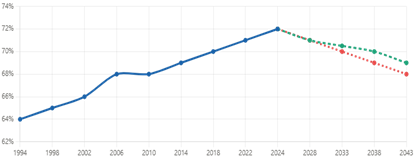 Source: Infometrics, Feb 2025. "Can labour force participation keep rising?
The available workforce is driven by three factors, and since 2024, all three of these factors have turned against us at the same time.
First up, net migration fell from 108,000 in 2023 to just 13,700 in 2025. The working holiday visa and skilled worker pathways that underpinned horticulture and nursery labour for the past 15 years have all but disappeared and are unlikely to come back at scale. Migration will face growing political resistance, rising competition from Australia and a shrinking pool of skilled migrants willing to come here.
Next, from 2026 onwards, the number of retiring workers will peak and begin to exit the workforce in volume, taking their knowledge with them. New Zealand has a high rate of people working over 65, but those workers do eventually retire and this begins shortly.
Finally, from around 2028 the pipeline of school leavers entering the workforce will plateau and begin shrinking. This flows directly from a drop in the birth rate that occurred from around 2014. Kids born since then will be the 18–24-year-olds entering our workforce over the next decade and there are fewer of them than in the past 30 years.
Secondary School Roll (2015-2035)
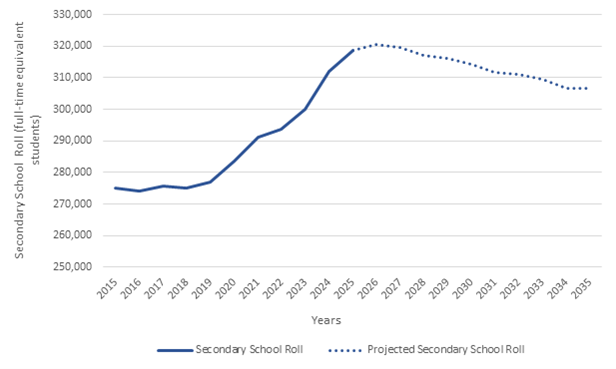 Source: Stats NZ - National Schools Roll Projections
School rolls are already falling and are projected to drop further by 2035. This means that the number of young people entering the workforce will stop growing from around 2028 and will then begin to slowly decline from that point.
It is even worse in the regions where people are ageing faster. The impact of labour scarcity hits the wider economy from 2030, but our regional producers should be planning for it in 2027, or 2028.
If, or when the economy improves there is scenario that long term unemployment levels could settle at 2%-3%, rather than the 4%-6% range we see today. There will be far fewer people looking for jobs.
The antidote for fewer workers is greater productivity. Our industry has not been standing still on this front. New Zealand's primary industries, including plant producers, have achieved some of the strongest productivity gains in the economy in recent years, meaning we are producing more value from the same inputs year on year.
Growth in Agriculture, Forestry & Fisheries Labour Productivity (1996 – 2024)
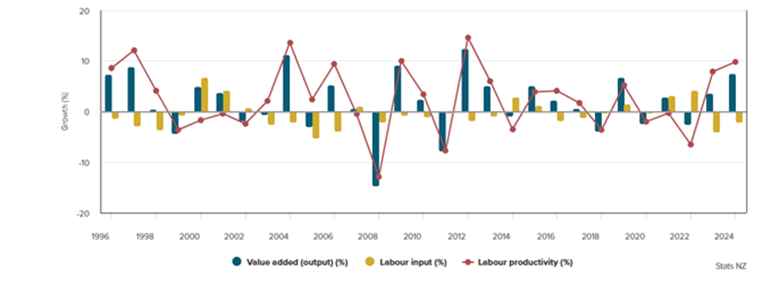 Source: Statistics NZ - Productivity statistics: 1978–2024
The primary industries have grown labour productivity consistently, but will need to continue to do this as labour tightens.
Many of our members have been investing heavily and strategically in technology. Automated potting and transplanting systems, precision irrigation and crop management are reducing the hours of physical labour required per unit of production, while lifting consistency and quality. The economics of these investments are improving as wage costs rise and labour tightens.
But another part of the nursery industry has deferred that investment, relying instead on flexible seasonal labour. That model is ending as the population that supplied that labour is getting structurally smaller. In five years-time labour intensive nurseries will experience higher wage bills, unreliable staffing, and their competitors who invested earlier will be producing plants at lower unit cost with more consistent quality.
Next, we need to prioritise training the next generation of horticulturalists. Many of our members are already investing in people at every level, building skills internally, and treating workforce development as a core business function rather than an HR cost.
Technology creates demand for people who understand data, machinery, and systems alongside their knowledge of horticulture production. There is a shift back to training old school 'horticulture systems' in workplace and University programmes. Interestingly, last year Massey University renamed its degree programme, ‘Bachelor of Horticultural & Plant Systems’, showing the trend.
Demography is destiny. What the numbers are telling us this year is that the workforce shift has arrived ahead of schedule.
No government policy or industry strategy alters the trajectory of the workforce in the short term. What we can change is how prepared our businesses are to operate within it.
The producers that will be strongest in 2030 are the ones making capital investment decisions and training their people. The window to get ahead of this is open right now, but it won't stay open indefinitely.
NZPPI is continuing to support people development through scholarships and with IPPS delivering the NZ Young Plant Producer of the Year competition. We are also working to connect our members with the work being undertaken by the Industry Standards Board to upgrade industry qualifications. We are also working with training providers that are developing the next generation of horticulturalists that have the skills and mastery needed to succeed in the future.